
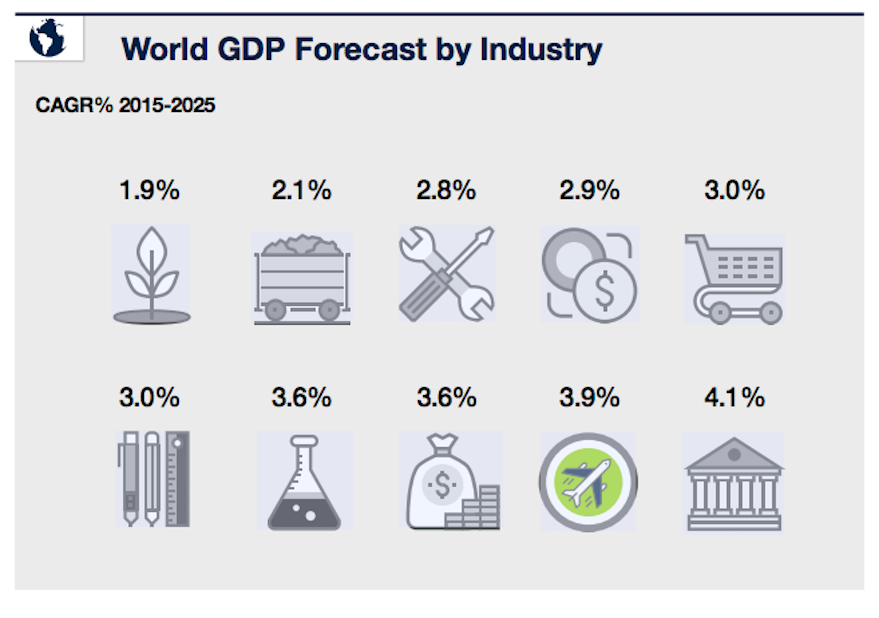
It is hardly surprising to see Travel among the top five verticals where brands run successful affiliate programs. We’re talking an industry with U.S. revenue nearing $400 billion by 2017, where more than 40% of consumer bookings happen either online or over mobile. I personally know affiliates who make good living from commissions paid to them by travel affiliate programs. From dedicated phone numbers to API solutions, many brands marketing through affiliates take it seriously and really go out of their way to equip and empower their partners to succeed …and help them succeed in the process as well.

Geno PrussakovCEO of AM Navigator
- Top affiliate programs receive only 3 percent of traffic from travel affiliate sites. This means that the majority of visitors aren’t ready to make a purchase, and stuck in a long conversion funnel. Additionally, it points out that there are a lot of opportunities for travel-focused projects because their users are laser-targeted.
- If you’re able to send more than 7 percent of your traffic to an advertiser, then you’re performing better than the average top affiliate site.
- Travel web content projects can send up to 50 percent of their traffic to an advertiser. This serves as proof of the importance of creating and maintaining your content strategy.
- The number one traffic source for affiliate sites is search. That’s something that you should keep in mind when you’re trying to attract more visitors.
- Local markets is a neglected opportunity. Among the top affiliates we found only a couple of projects that target local travel markets.
- Content projects that are focused on local markets and specific niches or a particular audience’s preferences perform the best.
- Newly launched affiliate web content projects need to publish approximately 15 articles per month. Our findings show that publishing this many posts will help you start generating at least 2,000 visitors in a period of 12 months.
- The minimum number of referring domains should be between 130 to 140. If you have a sufficient amount of good-quality content on your website, you should begin receiving anywhere from 1,000 – 2,000 organic visitors monthly.
Part 1: Top Affiliate Programs
Before introducing you to sections that are dedicated solely to affiliate industry websites, we think it’s important for us to explain how top affiliate programs work and whether they have enough opportunities for publishers (e.g., affiliate sites). In this section you’ll learn about how much traffic affiliate programs receive from advertisers working in the tourism niche, and which advertising networks they prefer.Methodology
It’s crucial to understand that the most common way of becoming an affiliate for a website dedicated to tourism is by:- Connecting with publishers through affiliate networks like CJ, Shareasale and VigLink.
- Working directly with affiliate sites.
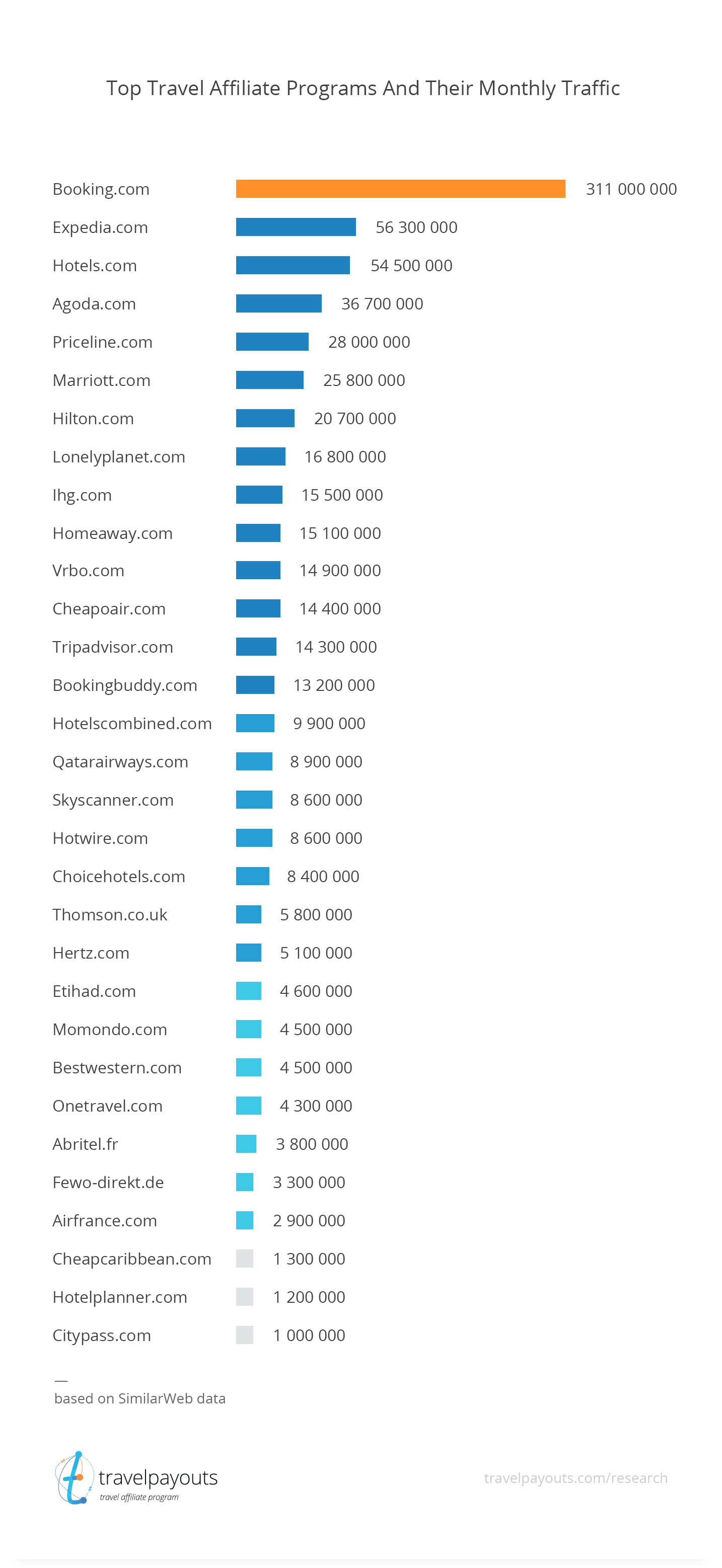
Three Major Pillars of Traffic Generation
Our research showed that the main traffic sources for the affiliate programs covered in our research are direct (47.81%), search traffic (35.52%), and referral (15.42%) traffic sources. According to a survey conducted by VigLink in May 2017 in which they asked 500 publishers and 100 merchants that are currently using affiliate marketing programs. VigLink’s survey found that many publishers claim to receive a lot more revenue from their affiliates. Alternatively, our research found that the amount of referral traffic sites get is two times lower than their amount of search traffic. On average, all of the researched affiliate programs receive a little over 15 percent of their traffic from their referring domains. However, most commonly, you will find that YouTube.com and Ask.com generate the majority of referral traffic among top referring sites, and affiliate websites do not seem to be bringing much traffic to the table. Tripadvisor.com receives more than 20,000 visitors on a monthly basis from Ask.com, which happens to be among top six traffic-generating sources. Also, the large number of users coming from YouTube confirms the importance of video content as a general trend. Choicehotels.com has over 17,000 visitors from YouTube, and they have a very well-maintained and entertaining channel. In one of their videos, they asked Asian American Hotel Owners Association (AAHOA) members about the biggest challenges for women in the hotel industry. Women entrepreneurs shared their personal experiences of success and failure, their hopes and their beliefs. Among other topics covered by Choicehotels.com on their YouTube channel are the skills required to launch a hotel business, how to become successful in these endeavors, and simple videos in which the company expresses its appreciation towards their clientele.Ad networks drive the most traffic
We have researched the following most popular ad network sites: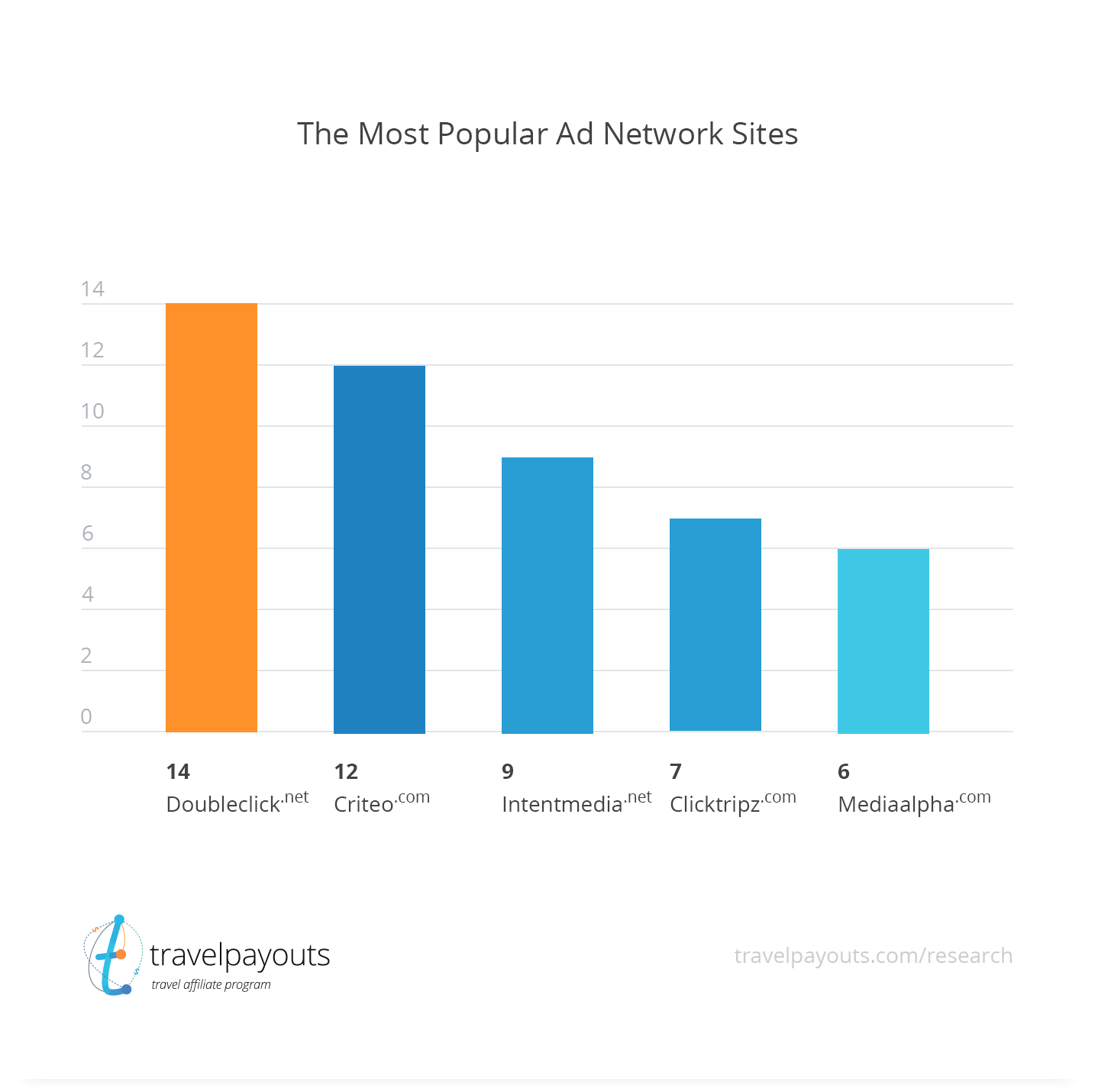
Top Affiliate Programs Receive Only 3% From Travel Industry Sites
We found that the number of visitors coming from tourism-oriented affiliate sites is unexpectedly small, and doesn’t account for more than 3 percent of total visitors. Among the sites that generate a substantial flow of referral traffic for top affiliate networks are news sites, game sites and tech portals. Those types of affiliate sites earn over 100,000 visitors on a monthly basis by placing banners on websites for all kinds of affiliate networks. On the other hand, we believe that affiliate networks are more interested in receiving relevant traffic that will guarantee more paid users. This means that travel advertisers are constantly looking for publishers that can bring the right type of users who are willing to make a purchase.Part 2: Top Affiliate Sites
Once you’ve established your affiliate marketing presence in the travel niche, it can be very profitable. We all work hard, or at least we think we do, so we spend a lot of money on vacations. The biggest problem with the travel niche when it comes to affiliate marketing is the competition. When you’re searching for something travel-related in Google, you see the same big players come up in search results. So how do you survive in such unfair conditions? No other tactic is going to help you more than staying observant and analyzing the steps those big players are taking. Your best way to become successful in travel affiliate marketing is by learning from the industry’s best of the best and imitating (not copying!) their ideas. In this section we’ll walk you through the steps top affiliate sites take to attract visitors and show you how much traffic, on average, they send to advertisers.Methodology
Due to the confidentiality of this type of data, there’s no way to get a list of the top affiliate sites. So we assumed that affiliates that made the list of the top referring traffic sources for the best affiliate networks would be the ones that match our criteria. So we collected a list of the top 30 referring traffic sites with the help of SEMrush Traffic Analytics, and then filtered out those irrelevant to the travel industry. Our final list includes 189 affiliate sites that work directly with affiliate programs and are fully dedicated to the tourism industry. We identified the main traffic sources for those sites, and analyzed what kind of strategies they are utilizing.On Average, a Top Affiliate Site Sends 7 Percent of Its Traffic to Big Advertisers
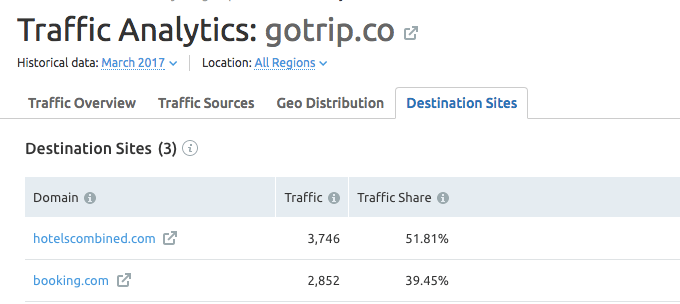
This number was calculated across all affiliates sites that send traffic to top advertisers (we listed those companies in our previous section). What’s even more fascinating is that affiliates with the same traffic flow don’t seem to perform alike. For example, Bookingbuddy.com and Cheapflights.com has around two million visitors on a monthly basis, but the former site sends 1.9 times more traffic to advertisers than the latter. Regardless of this finding, we were able to spot websites that show better results. For instance, Independenttraveler.com sends more than 15 percent of its traffic to Bookingbuddy.com, Tripadvisor.com, Cheaptickets.com and Airfare.com.Of All the Sites We Analyzed, 10 Percent Have Less Than 100,000 Visits a Month
This finding points out that even if you don’t have a lot of visitors that happen to be interested in the tourism industry, there are enough chances to start generating a sustainable amount of money. We’ve also noticed that the smaller a site is, the more traffic it sends to advertisers. Owners of smaller projects care more about their performance, and try to maximize their profit. We found out that Flynous.com sends more than 25 percent of its traffic to various advertisers by regularly publishing special offers from different airline companies. We find it very interesting that all the short messages they publish are not only remarkably compelling, but they also generate visitors from Google.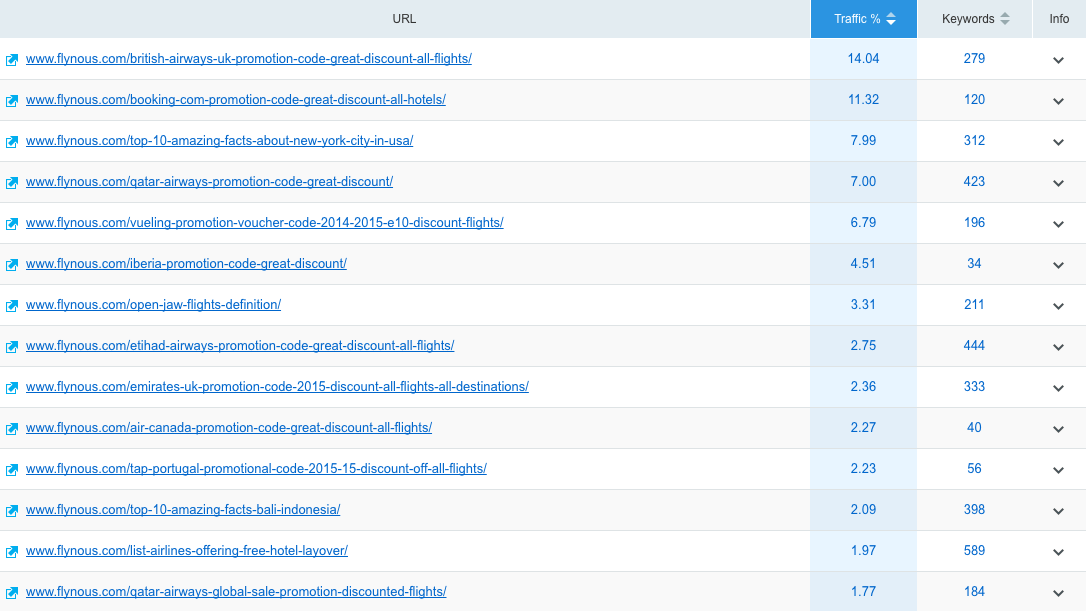
Web Content Project Sites Send Over 40 Percent of Their Traffic to Advertisers
In our list of the top 10 affiliates that send the the most traffic to advertisers on a monthly basis, we found that 40 percent of sites happen to be content project sites. We asked Oliver Roup, CEO of ViGlink, an outbound-traffic monetization service for publishers, forums, and bloggers, in San Francisco, to comment on the situation with web content project sites:We see readers closely engage with our publishers’ unique content. Readers look to the influential publishers they trust most to be the experts whose advice they rely on to make product purchase decisions. This unique bridge between consumer and a publisher’s content supports the trusted relationship consumers need before completing a purchase. The result is a high-conversion environment that is tough to recreate without that bond of trust between both parties.

Oliver RoupCEO of ViGlink
Local Markets are an Overlooked Opportunity
We discovered that a small number of affiliate sites are focused on local markets, which seems to be an overlooked opportunity. For instance, the Spanish-speaking travel market is the biggest in the world. Recently, the Hispanic community was identified as the fastest-growing segment of the U.S. population, spending $5.66 billion annually on travel. And in our sample list, we spotted a project that helps Spanish-speaking travellers explore New York. Homeaway.com is an exception that stands out because they have a decent number of advertisers that target local markets. In the screenshot below you can see its top referring sites: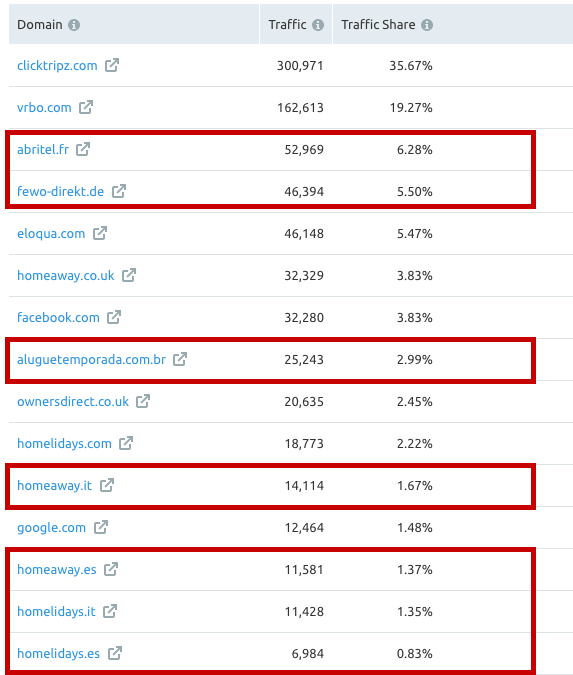
Part 3: Small- and Medium-sized Affiliate Sites
We selected a random sample of 381 small (less than 20,000 monthly visitors) to medium (20,000 to 100,000 monthly visitors) affiliate sites. These sites aren’t top industry leaders, but they know how to convert traffic and generate money, and they do it well. What you’ll learn in this section:- How much traffic a beginner affiliate site in the tourism industry must have to begin generating income
- What type of affiliate sites send more traffic to advertisers
- How many referring domains you need to have to start receiving a decent number of visitors from organic search
Methodology: How Did We Gather This Data?
We selected a list of keywords that affiliate travel blogs rank for in Google. These search queries include terms like “travel blog,” “cheap flights,” “cheap tickets,” “how to travel around the world,” etc. Then we built a list of sites that rank for these keywords on the first 10 pages of Google. The last step was to filter out affiliate sites. We did this by looking up links and code elements that consist of the following parameters:- tradedoubler.com/click?p=224458
- http://tc.tradetracker.net/*c=19390*
- <script src=”https://www.mediawego.com/farmer/wego.farmer.js”
- src=’//static.dohop.com/js/packages/flightform_script_package.js
- http://content.skyscnr.com
- <form id=””b_frm”” action=””//www.booking.com/searchresults.html”” method=””get”” target=””_blank”” onsubmit=””return sp.validation.validSearch();””
- Medium — 46%
- Small — 45%
Typically, small affiliate sites send 11 percent of their overall traffic to advertisers (based on analyzed sites)
As mentioned previously, small sites tend to perform better when it comes to sending users to advertisers. This number (11 percent) is 1.57 times higher than the one of top affiliates’ (as previously mentioned, a top affiliate site only sends 7 percent of its traffic to big advertisers). Also we’ve noticed that projects focused on a specific problem or centered around a particular location can send up to 40 percent of their traffic to advertisers. Lasvegas-entertainment-guide.com is an excellent example of a medium-sized site that is performing far beyond other average sites of its kind. Lasvegas-entertainment-guide.com also works with affiliates that link to industry-relevant content in their own articles: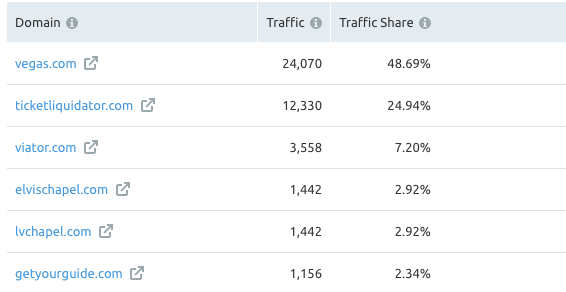
Sites that have less than 10,000 visitors a month send up to 17 percent of their traffic to an advertiser
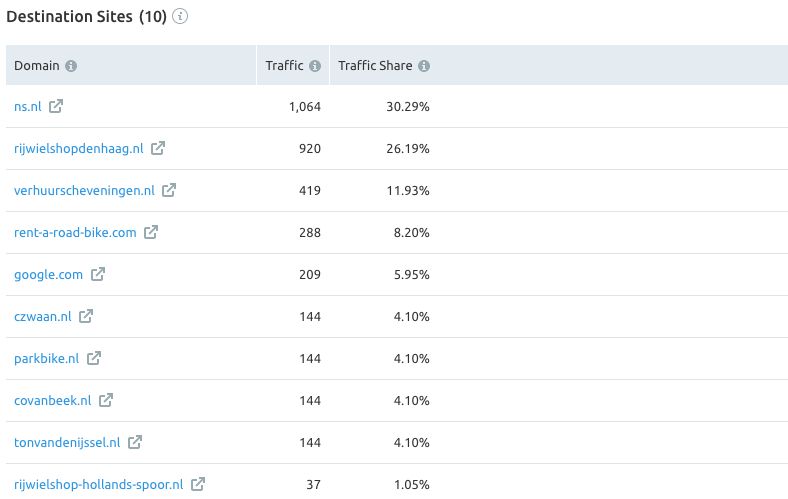
Basically, this means that you can start generating your first commission even if your site only has 10,000 visitors per month or even less. Keep in mind that in order to ensure your success, your users should be directed from relevant content pages. Additionally, our survey showed that 57 percent of surveyed experts believe that having 5,000 monthly visitors or less is enough, and 22 percent think that you need to have between 5,000 to 10,000 visitors. Let’s look at Holland-cycling.com, a local Dutch website promoting traveling around the country by bicycle. This website sends almost zero users to Booking.com because they have added a search box on their main page:
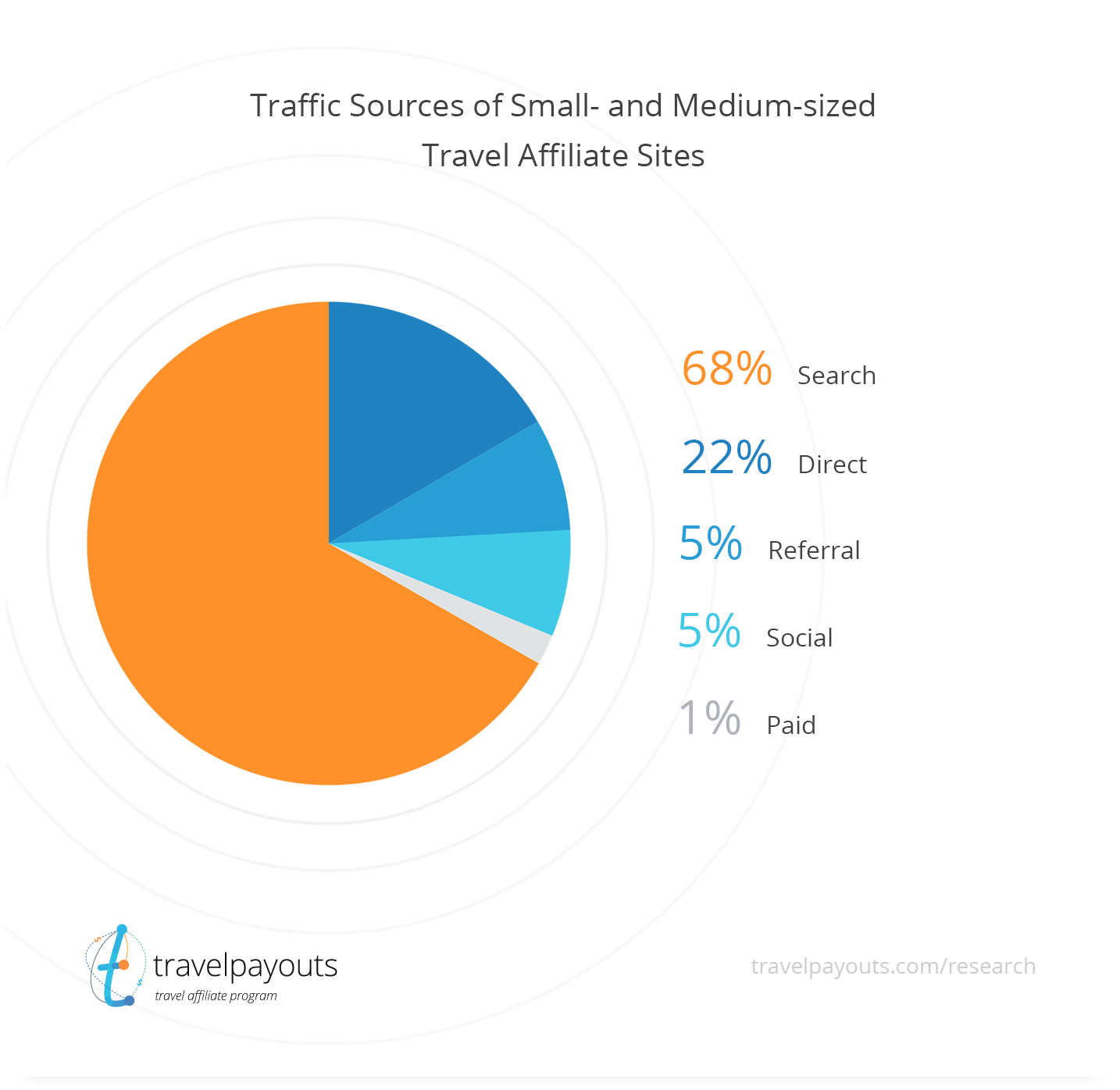
The majority of visitors still come from search traffic
Traffic Distribution:- Direct — 22%
- Referral — 5%
- Search — 68%
- Social — 5%
- Paid — 1%
Content projects that are focused on local markets and specific niches have the best performance
Non-English content projects on average send 30 percent of their traffic to advertisers compared to the 25% sent by English websites. So if you can launch a project in any other language besides English, that will allow you to generate money faster. Besides that, non-English projects require less referring domains. For instance, Podoroznik.co.uk has over 2K visitors per month from organic search and only 47 referring domains. The results of our expert survey also confirm that 65 percent of affiliate experts claim that web content projects focused on local markets tend monetize faster. Targeting narrow niches and specific needs seem to be another great way of generating more money. Luxeadventuretraveler.com was launched in July 2016 , and is now sending a steady amount of traffic to affiliates. The company writes reviews about luxury hotels, and in their reviews you can always find a link to, for example, Booking.com to book a hotel room.On average, the sites we analyzed have 537 referring domains
This number is based on data provided by Ahrefs insights. Sites that have 10,000 monthly visitors or less have 275 referring domains. If you’re shooting for one to two thousand visitors a month, you need 136 referring domains to reach this goal.54% of analyzed sites don’t have social media traffic
This is a bad trend because the majority of those sites are content-generated, which means that they need a loyal audience. SMM channels allow you to generate traffic instantaneously, even though this traffic will mostly consist of users that aren’t ready to convert right away, but they will help you get more links and users back to your site.Sites have around 4.8K pages that are indexed by Google (based on the sites we’ve analyzed)
This data was gathered using the SEOquake toolbar. Websites that were launched between 2015 and 2016 have 1.3K indexed pages. Although, this doesn’t necessarily mean that you need to have that many indexed pages (e.g., content pages) in order to start receiving your first organic visitors. Shout.sg was launched in 2016 and now has 566 indexed pages that bring over 9,000 Google search visitors a month. This travel project is about things to do and see while in Singapore. They regularly update their site with upcoming events. Another great example is Listravelplans.com, a personal blog that was started in August 2015. Currently it has 125 indexed pages and 1.3K visitors from Google.Sites that have less than 1,000 indexed pages in Google, publish five articles per month
To calculate this number, we used data from Webarchive.org — a website that archives the changes that all websites have gone through ever since they were founded. So to get these results, we divided the number of months that have passed since the day Webarchive.org first registered a new site by its number of indexed pages in Google. The results showed that you need to publish one article per week, which isn’t a lot. However, it’s worth mentioning that newly launched websites should post two articles a week and around 15 articles per month. Nomadphilipines.com posted more than 25 posts per month between 2015 and 2016, and, in general, statistics confirm that you need to post as as often as you can if you’ve recently launched your site.In lieu of a conclusion
After polling industry experts and assembling data, we were able to prove that you don’t need to have an abundant flow of traffic to your website to have a profitable business. Also, consider starting a content project or transforming your existing site into one, as placing links in relevant articles outside your website will bring you more clicks, and as a result, more visitors. Try to keep your number of referring domains between 130 to 140. If you have good-quality pieces of content published on your website, you should begin receiving anywhere from 1-2K organic visitors monthly. Additionally, our data-driven research confirms that the current environment of the affiliate travel market has favorable conditions for generating revenue even if one decides to work with dominant affiliate programs.
You may also be interested in